In-situ testing forms the cornerstone of reliable geotechnical engineering in Overland Park, providing direct measurements of soil and rock properties without the disturbance inherent in laboratory sampling. This category encompasses field investigations that evaluate density, strength, permeability, and deformation characteristics under actual site conditions. For a city experiencing sustained commercial and residential growth, these tests are not merely procedural—they are essential for validating design assumptions, ensuring structural safety, and complying with local building codes. The data gathered through in-situ methods directly informs foundation design, retaining wall construction, pavement engineering, and earthwork quality control, making it a critical investment for any project that interacts with the ground.
Overland Park sits within the Osage Plains physiographic region, underlain by Pennsylvanian-age sedimentary rocks including alternating limestone and shale sequences of the Kansas City Group. The overlying soils are predominantly residual silty clays derived from weathered shale and limestone, often exhibiting expansive characteristics that pose challenges for light structures and pavements. Loess deposits mantle the upland areas, while alluvial silts and sands occupy the stream valleys. This geologic variability demands a tailored approach to site investigation. A one-size-fits-all testing program is inadequate when a single site can transition from stiff, overconsolidated clay to weathered bedrock within a few vertical feet. Understanding these subsurface conditions through direct measurement is the only way to mitigate the risk of differential settlement, slope instability, or groundwater-related construction difficulties.
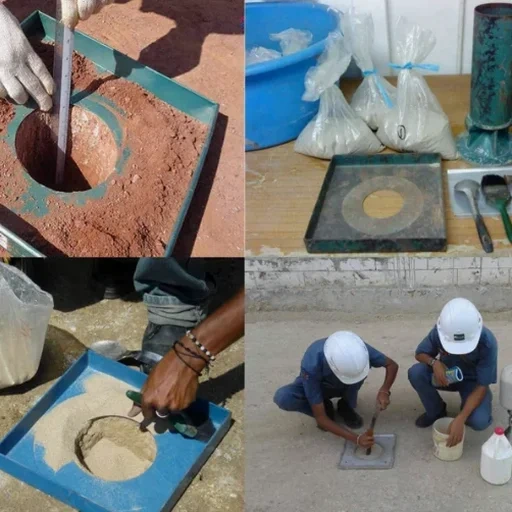
The primary national standards governing in-situ testing in the United States are published by ASTM International. Key specifications include ASTM D1556 for the sand cone method, ASTM D1195 and D1196 for plate load testing, and ASTM D6391 for field permeability testing using packers or borehole methods. While Kansas does not mandate a unique state-specific geotechnical code, local municipalities like Overland Park enforce the International Building Code (IBC), which references ASTM standards for acceptance criteria. Chapter 18 of the IBC requires a geotechnical investigation for all structures and explicitly allows the use of in-situ testing to determine allowable bearing pressures, lateral earth pressures, and soil classification. Engineers practicing in Johnson County must ensure their testing programs align with these referenced standards to secure permit approval and deliver defensible reports to regulatory authorities.
The range of projects requiring in-situ testing in Overland Park is broad. Commercial developments in the College Boulevard corridor often demand plate load tests to confirm bearing capacity for heavily loaded footings and mat foundations. Transportation infrastructure projects, including the expansion of U.S. 69 and local arterial roads, rely on field density testing using the sand cone method to verify compaction of structural fill and subgrade materials. Stormwater management facilities and detention basins frequently necessitate field permeability testing using Lefranc or Lugeon methods to assess infiltration rates and groundwater flow paths. Residential subdivisions on the city's expanding southern fringe also benefit from these techniques, particularly where cut-and-fill operations require documented density control to prevent long-term settlement issues.
Common questions
What is the difference between in-situ testing and laboratory testing of soils?
In-situ testing measures soil properties in their natural state—with original stress conditions, moisture content, and fabric intact—while laboratory tests are performed on disturbed or undisturbed samples extracted from the ground. In-situ methods like the plate load test or sand cone density test avoid sample disturbance effects that can alter strength and compressibility data, providing a more representative picture of field behavior, though they may test a smaller volume of material.
When is in-situ testing required by the building code in Overland Park?
The International Building Code, adopted by Overland Park, mandates a geotechnical investigation for every structure. In-situ testing is required whenever soil classification, bearing capacity, compaction control, or permeability must be determined for design. The code does not prescribe a specific test for every scenario but requires that the investigation be sufficient to evaluate site conditions. The engineer of record selects the appropriate ASTM-standardized in-situ methods based on the proposed construction and subsurface variability.
How many in-situ tests are typically needed for a commercial building site?
The number of tests depends on site size, geologic complexity, and structural loads. A single-story commercial building on uniform soil may require a few plate load tests at footing elevations and several density tests on compacted fill. For larger or irregular sites, a grid pattern of boreholes with permeability tests might be supplemented by multiple plate load tests across different locations. ASTM standards provide minimum frequencies, but the geotechnical engineer adjusts the program to achieve statistically representative coverage.
Can in-situ testing help identify expansive soils common in the Kansas City area?
While in-situ testing does not directly measure expansion potential—that typically requires laboratory Atterberg limits and swell-consolidation tests—it provides crucial supporting data. Field density and moisture content measurements from the sand cone method indicate compaction state, which influences swell behavior. Plate load tests conducted on moisture-conditioned soil can reveal stiffness changes that correlate with expansive tendencies. A complete investigation usually pairs in-situ tests with laboratory index testing to accurately characterize expansive soil risk.