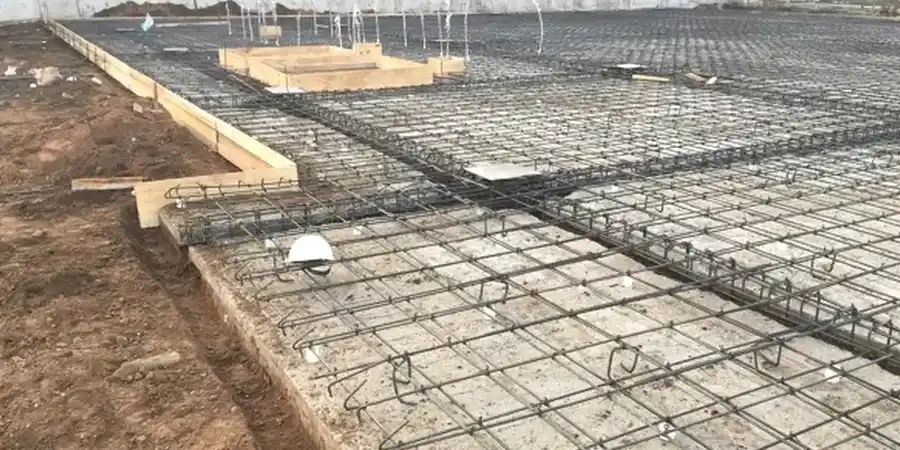
Overland Park sits on a terrain of rolling hills underlain by shale and limestone, with a thick mantle of stiff to very stiff residual clay that swells and shrinks with the seasons. That seasonal volume change, combined with a frost depth of about 30 inches, means a conventional spread footing can heave unevenly across a single structure. A raft foundation design redistributes those differential movements, and we usually specify a rigid mat when the estimated total settlement under isolated footings would exceed 1 inch. The typical stratigraphy we deal with here starts with 4 to 12 feet of lean clay (CL) over weathered shale, and before we size the mat we often run a CPT test to map continuous tip resistance through the desiccated crust. For projects near Indian Creek or the Blue River floodplain, where softer alluvium appears, we also bring in SPT drilling to confirm blow counts below the proposed mat elevation.
A rigid mat foundation in Overland Park clay turns differential heave into tilt — predictable and manageable with a proper modulus of subgrade reaction.
How we work
Site-specific factors
The mistake we see repeatedly in Overland Park is treating a mat foundation as just a thick slab on grade, skipping the geotechnical investigation for the subgrade modulus. A contractor assumes the clay is uniform, pours a lightly reinforced mat, and two years later the corners of the building have lifted 1.5 inches relative to the center because the moisture content under the perimeter equilibrated with the wetter exterior soil. That kind of differential movement cracks partition walls and jams doors. Another classic error is ignoring the perched groundwater that sits on top of the shale after heavy spring rains — without a capillary break and a positive drainage layer, hydrostatic pressure builds under the mat and reduces the effective bearing pressure to nearly nothing at the edges. A proper raft foundation design for this area has to account for both the edge moisture variation zone (typically 5 to 8 feet inward) and the seasonal high groundwater level.
Standards used
IBC 2021 Chapter 18 (Soils and Foundations), ASCE 7-22 Chapter 20 (Site Classification), ACI 318-19 Chapter 13 (Mat Foundations), ASTM D1586-18 (SPT for subgrade modulus correlation), ASTM D2487-17 (Unified Soil Classification)
Linked services
Subgrade Modulus Determination
We derive ks from plate load tests (ASTM D1195/D1196) on compacted subgrade or from SPT N-value correlations calibrated to local clay. The result feeds directly into the finite element or Winkler spring model for the mat.
Settlement and Heave Analysis
Using consolidation test data (ASTM D2435) and suction profiles from the upper 10 feet, we calculate total and differential settlement under the mat, including edge heave scenarios from seasonal moisture fluctuation.
Structural Geotechnical Report for Mat Design
This report delivers allowable bearing pressure, ks values for center and edge zones, frost protection recommendations, drainage specifications, and seismic site class — everything the structural engineer needs to run the mat reinforcement design per ACI 318.
Typical parameters
Common questions
When is a raft foundation better than isolated footings in Overland Park?
A raft makes sense when the total settlement under individual footings would exceed 1 inch, or when column spacing is tight and footings would overlap. In Overland Park's expansive clay, a rigid mat also reduces differential heave by forcing the structure to tilt as a unit rather than warping at each column line.
What is the typical cost range for a raft foundation geotechnical design package?
For a residential or light commercial mat foundation in Overland Park, the geotechnical investigation and design report typically runs between US$1.020 and US$3.690, depending on the number of borings, laboratory tests (consolidation, swell, Atterberg), and whether a plate load test is required.
Which laboratory tests are essential for a mat foundation design here?
At a minimum we need Atterberg limits (ASTM D4318) to confirm expansion potential, one-dimensional consolidation (ASTM D2435) for settlement parameters, and unconfined compression on undisturbed samples. For larger mats, we add swell-consolidation and suction tests to model the edge moisture variation zone.
How deep should the mat be placed in Overland Park's soil?
The bottom of the mat should be at least 30 inches below finished grade to satisfy frost protection per IBC. Where expansive clay is present, we often recommend excavating to 36 or 42 inches and placing a compacted granular capillary break between the mat and the natural clay to cut off moisture migration.