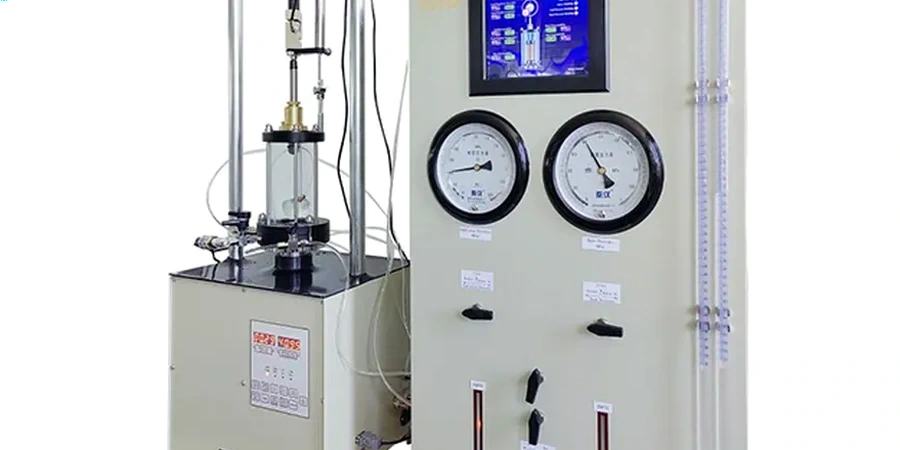
Overland Park sits on a geological transition zone where Pennsylvanian-age shale, limestone, and sandstone interlayer unpredictably, leaving residual soils that range from stiff fat clays to weathered rock within a few vertical feet. This variability creates a direct challenge: standard penetration testing alone cannot reliably capture the effective stress parameters needed for foundation design on slopes or deep excavations. The triaxial test becomes indispensable here because it replicates the in-situ confining pressure and drainage conditions that govern shear strength in saturated clay layers common across Johnson County. When we run a consolidated-undrained (CU) program with pore pressure measurement, we isolate the phi-prime and c-prime values that a drained slope stability analysis demands—especially critical where the Indian Creek and Blue River tributaries have carved steep bluffs that concentrate runoff and raise groundwater temporarily after heavy spring storms. For projects near the 135th Street corridor, where limestone pinnacles sit beneath compressible clays, pairing triaxial data with a deep excavation monitoring plan provides the full picture engineers need before a single cubic yard of soil is removed.
Effective stress friction angles in Overland Park residual shale typically range from 22 to 28 degrees—a narrow band that makes the difference between a factor of safety of 1.2 and 1.5.
How we work
Site-specific factors
A five-story mixed-use building near College Boulevard was designed with a mat foundation bearing on stiff lean clay at 12 feet below grade. The preliminary geotechnical report used SPT N-values and textbook correlations to estimate undrained shear strength at 2,000 psf. We extracted thin-wall Shelby tube samples from the bearing stratum and ran a CU triaxial suite at three confinement levels matching the design stress range. The effective stress envelope revealed a phi-prime of only 24 degrees, and when we modeled drained long-term conditions with the groundwater table rising seasonally to within 6 feet of the base of the mat, the factor of safety dropped to 1.15—well below the IBC 1.5 requirement for static conditions. The fix involved deepening the excavation by 4 feet and installing a perimeter underdrain system that tied into a grouting program to seal weathered fractures in the underlying limestone. Without the triaxial data, the original design would have gone to construction with a hidden long-term stability deficit. In a city that added over 7,000 new housing units between 2020 and 2023, the pressure to accelerate approvals is real, but skipping advanced laboratory testing on high-plasticity Overland Park clays turns a six-week lab program into a multi-year liability.
Standards used
ASTM D4767-11: Standard Test Method for Consolidated Undrained Triaxial Compression Test for Cohesive Soils, ASTM D2850-15: Standard Test Method for Unconsolidated-Undrained Triaxial Compression Test on Cohesive Soils, ASTM D7181-20: Standard Test Method for Consolidated Drained Triaxial Compression Test for Soils, AASHTO T-297: Standard Method of Test for Consolidated Undrained Triaxial Compression Test
Linked services
CU Triaxial with Pore Pressure Measurement
Consolidated-undrained testing per ASTM D4767 on undisturbed Shelby tube samples. Provides effective stress shear strength parameters (c', φ') and Skempton's A coefficient for Overland Park residual clays and weathered shale.
UU Triaxial for Total Stress Analysis
Unconsolidated-undrained testing per ASTM D2850 for rapid loading scenarios. Delivers undrained shear strength (Su) for short-term bearing capacity and temporary excavation stability in saturated fat clay layers.
CD Triaxial for Drained Strength Envelope
Consolidated-drained testing per ASTM D7181 for coarse-grained soils and long-term slope stability. Applied when granular interbeds within the glacial till require drained parameters for limit equilibrium modeling.
Multi-Stage Triaxial on a Single Specimen
Cost-effective program where a single sample is sheared at increasing confinement levels. Suitable for deep boreholes with limited recovery, common when penetrating the Argentine Limestone member beneath the surficial clays.
Typical parameters
Common questions
How many triaxial specimens do we need for a typical Overland Park commercial building foundation?
For a single bearing stratum, three CU specimens at different confining pressures—typically 15, 30, and 45 psi for a 2-to-3-story building—are the minimum to define a Mohr-Coulomb failure envelope. We add a fourth specimen when the boring log shows variable plasticity or sand partings within the same layer.
What is the cost range for a CU triaxial test program on three specimens?
A three-specimen CU triaxial program with pore pressure measurement, including sample extrusion, trimming, back-pressure saturation, consolidation, and shear, ranges from US$1,790 to US$2,790 depending on the sample condition and the need for multi-stage consolidation steps on high-plasticity clays.
How do you handle sample disturbance in Overland Park's weathered shale?
We evaluate disturbance using the change in void ratio during reconsolidation in the triaxial cell per Andresen and Kolstad (1979) criteria. When disturbance exceeds 4 percent volumetric strain, we apply strain-correction procedures per Ladd and DeGroot (2003) to recover the field strength envelope as closely as possible.
Can we use triaxial results directly in a PLAXIS or FLAC 3D model?
Yes—the effective stress parameters c' and phi' from a CU triaxial program, along with the dilatancy angle derived from volumetric strain data, are direct inputs for the Hardening Soil and Mohr-Coulomb constitutive models used in most Overland Park deep foundation and excavation designs.