Geotechnical laboratory testing forms the backbone of safe and economical construction in Overland Park, providing the critical data engineers need to understand soil and rock behavior before a single foundation is poured. In a region marked by expansive clay soils, variable bedrock depths, and seasonal moisture fluctuations, relying on visual classification alone is simply not enough. Laboratory analysis quantifies strength, compressibility, permeability, and volume-change potential, transforming site geology from an unknown risk into a manageable design parameter. For developers, municipalities, and homeowners alike, investing in a comprehensive laboratory program is the most effective way to prevent structural distress, pavement failure, and costly post-construction repairs.
The local geology of Overland Park is dominated by Pennsylvanian-age cyclothems, characterized by alternating sequences of limestone, shale, and sandstone overlain by residual clays and loess-derived silts. These residual soils, particularly the fat clays common to the upland areas, are notorious for their high plasticity and shrink-swell potential. Understanding these specific characteristics requires specialized testing beyond simple grain-size analysis. For instance, determining the precise moisture content at which a soil transitions from a semi-solid to a plastic state is essential for predicting its behavior during wet-dry cycles, a critical concern in Johnson County's climate. This is where precise index property tests become invaluable for foundation design.
All laboratory procedures in Overland Park must conform to the standards set forth by the American Society for Testing and Materials (ASTM), as mandated by local building codes and the Johnson County Department of Planning and Codes. These nationally recognized standards ensure consistency, repeatability, and legal defensibility of the results. Whether you are determining shear strength parameters for a retaining wall design or evaluating subgrade stiffness for a roadway project, adherence to ASTM D422, D4318, D2435, and D2850 is non-negotiable. The Atterberg limits test, governed by ASTM D4318, is a fundamental suite of index tests used to classify fine-grained soils and quantify their plasticity, directly correlating to their shrink-swell potential—a primary design consideration in our area.
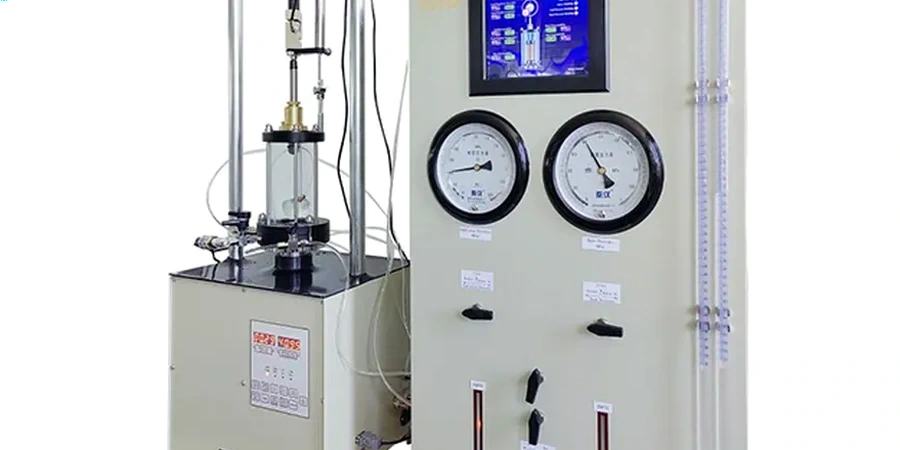
The scope of projects requiring rigorous laboratory testing in Overland Park is vast, ranging from high-density residential subdivisions and commercial pad sites to public infrastructure and stormwater management systems. A structural engineer designing a deep foundation system for a multi-story office building near College Boulevard needs undisturbed sample testing to determine soil modulus and undrained shear strength. Conversely, a contractor placing compacted fill for a new warehouse floor relies on modified Proctor tests and direct shear results to verify compliance with project specifications. For critical applications where the relationship between lateral earth pressure and axial strain must be precisely defined, the advanced triaxial test provides a sophisticated simulation of in-situ stress conditions, offering vital data that simpler shear tests cannot replicate.
Available services
Common questions
What is the primary purpose of a geotechnical laboratory testing program?
The primary purpose is to move beyond visual soil classification and quantify the physical, mechanical, and hydraulic properties of subsurface materials. This data is essential for engineers to design safe foundations, assess slope stability, predict settlement, and select appropriate construction materials, ensuring structures are not compromised by unexpected ground behavior or expansive soil conditions.
Why are laboratory tests necessary for construction in Overland Park specifically?
Overland Park's geology features expansive, high-plasticity clays and variable bedrock that are highly sensitive to moisture changes. Laboratory tests are the only reliable way to measure this shrink-swell potential and quantify strength parameters. Without this data, foundation designs risk severe cracking, heaving, and differential settlement due to the region's seasonal wet-dry cycles.
Which national standards govern geotechnical laboratory testing in the United States?
Geotechnical laboratory testing in the United States is governed by ASTM International standards. These include specific designations for classification (D2487), Atterberg limits (D4318), compaction (D1557), consolidation (D2435), and shear strength tests like the triaxial test (D2850/D4767). Compliance with these ASTM methods is mandatory for regulatory approval in Overland Park.
How do laboratory results influence the type of foundation recommended for a project?
Laboratory results directly dictate foundation selection by revealing soil strength, compressibility, and expansion potential. For example, low shear strength from a triaxial test might necessitate deep foundations bypassing weak strata, while high plasticity index values from Atterberg limits testing often lead to recommendations for structural slabs or drilled piers to mitigate shrink-swell damage.